Plastics in Agriculture

The use of plastics in agriculture helps farmers increase crop production, improve food quality and reduce the ecological footprint of their activity. Not only do plastics allow for vegetables and fruits to be grown throughout the year, no matter the season, these products are also usually of better quality than those grown in an open field.

Innovative and sustainable solutions: Thanks to the use of different plastics in agriculture, water can be saved and crops can even be planted in deserts. Plastic irrigation pipes prevent wastage of water and nutrients, rain water can be retained in reservoirs built with plastics, and the use of pesticides can be reduced by keeping crops in a closed space such as a greenhouse or, for mulching, under a plastic film.

Greenhouses and tunnels

Greenhouses and tunnels are like intensive-care units. Plants are exposed to the sunlight and can grow in ideal conditions, with protection from harmful external conditions.

Plastic reservoirs and irrigation systems

When combined, plastic reservoirs and plastic irrigation systems make an essential contribution to water management. Water can be stored in dams covered with plastic to avoid leaking and distributed via pipes, drop irrigation systems and systems for water circulation.

Silage

This application, which was developed to store animals’ grain and straw during the winter, is another proof of the value of plastics. Plastic films used to store silage are resistant and the content can be stored for years.

Other applications

 Include boxes; crates for crop collecting, handling and transport; components for irrigation systems like fittings and spray cones; tapes that help hold the aerial parts of the plants in the greenhouses, or even nets to shade the interior of the greenhouses or reduce the effects of hail.

A wide range of plastics are used in agriculture, including, polyolefin, polyethylene (PE), Polypropylene (PP), Ethylene-Vinyl Accetate Copolymer (EVA), Poly-vinyl chloride (PVC) and, in less frequently, Polycarbonate (PC) and poly-methyl-methacrylate (PMMA).


Recycling and recovery opportunities: At the end of their life cycle, agricultural plastics such as greenhouse covers can be recycled. Once retrieved from the fields, plastics are usually washed to eliminate sand, herbs and pesticides, before being ground and extruded into pellets. The material can then be used again in the manufacturing of articles such as outdoor furniture.

Courtesy of PlasticsEurope.

Plastic piping – supplying our communities

Plastic piping networks form an integral, expensive, long term and extremely important part of the infrastructure of this country.

Plastic piping is used across the complete spectrum of many industries – mining, civil, irrigation, industrial, telecommunication and building. Around 150 000 tons of pipe (PVC and HDPE) is produced annually in South Africa, representing many thousands of kilometers.

High Density Polyethylene (HDPE) piprd are known for their durability, flexibility, and overall resistance to environmental stress. They are also leak-free and corrosion resistant.

The integrity of these networks, built up over many years is of critical importance, serving the water supply and sewage disposal needs of many millions of people.

Plastic is clearly no longer an alternative pipe material, but has grown to a dominant position in piping systems worldwide, with an estimated share of more than 50%.

South Africa is a dry country and water is a scarce resource. With increasing demand and inconsistent rainfall, we can no longer afford the huge losses in pipelines (estimated to be in the order of 40%). The need is for piping systems that are leak-free and durable for extended lifetimes, up to 100 years.

HDPE and PVC pipes answer this call with distinction. In addition, it is highly suitable for the rehabilitation of old pipelines.

For more information visit www.sappma.co.za (SA Plastic Pipe Manufacturers Association)

Who will really benefit from increased levies raised on plastic bags?

South Africans breathed a collective sigh of relief last week when Finance Minister Tito Mboweni announced that the tax threshold of income earners has been lowered and when nothing came of the dreaded VAT increase during the 2020 Budget Speech.

Whilst it was good news for consumers, the Minister made it clear that certain other taxes and levies would need to be raised in order to bolster the State’s coffers. To this end, he announced an increase in the plastic bag levy from 12c to 25c at the beginning of April 2020. Moreover, the Budget Review revealed that National Treasury will also be consulting on extending the current levy on plastic bags to all single-use plastics used for retail consumption, including plastic straws, utensils and packaging in 2021. An assessment of the current levy, including a clarification of the tax treatment of compostable bags, will be undertaken.

According to Plastics SA Executive Director Anton Hanekom, Minister Mboweni’s announcement of the increased plastic bag levy was clearly framed within the context of the green economy and conveyed the impression that the funds raised will be used to mitigate climate change.

“If the expected R250 million generated from raised levies is used to boost recycling and grow a circular economy, we would welcome and support the Minister’s announcement. However, past experiences (such as the failed Buyisa e-Bag initiative) have shown that Government views the plastic bag levy as an easy way to raise funds to pay for other projects that have nothing to do with the environment,” Hanekom says.

Plastics|SA calculates that almost R2 billion was raised through the levy on plastic carrier bags since it was first introduced in 2004. The levy was applied to the manufacturers of the plastic bags, but passed on to consumers. Bags were prescribed to have a thickness of 30 microns to aid recycling and promote reuse, in terms of an agreement that was reached between the departments of environmental affairs, labour and businesses.

“A section 21 company, Buyisa-e-Bag, was established to administer the funds by promoting waste minimisation and awareness initiatives in the plastics industry, expanding collector networks,  creating jobs, as well as kick-starting rural collection by empowering Small Medium and Micro Enterprises (SMMEs) and creating additional capacity in non-governmental organizations (NGOs). However, the project quickly failed and less than half of the money raised went towards recycling projects. The rest was channelled into the National Revenue Fund and allocated to government departments,” Hanekom explains.

Despite the lack of government funding, the South African plastics recycling industry continued to record year-on-year growth. In 2018 alone 352 000 tons of plastics were recycled into raw material, achieving an impressive input recycling collection rate of 46.3 % for all plastics. It created permanent employment for 7 800 people and a further 58 500 income-generating jobs during this year.

“In recent years the plastics industry has made important strides forward aimed at addressing the issue of plastic bags polluting the environment. For example, plastic bag manufacturers agreed to remove fillers in order to produce bags that are fully recyclable. In addition, recycled plastic material is now used to produce most of the carrier bags sold in South Africa today. We have created an end-market for recycled plastic products and dramatically reduced the amount of waste being sent to landfill. By ensuring that the products we create become part of a circular economy, we create a win-win situation for the environment and for the industry,” Hanekom says.

“The plastics and packaging industries continue to work in close consultation with the Department of Environment, Forestry and Fisheries (DEFF) and other interest groups around developing an Extended Producer Responsibility scheme. It is our sincere hope that the money raised through the new plastic bag levy will be ring-fenced for the recycling industry and that the entire process will be managed with transparency, accountability and clear communication to all the parties concerned,” Hanekom concluded.

For more information, visit www.plasticsinfo.co.za


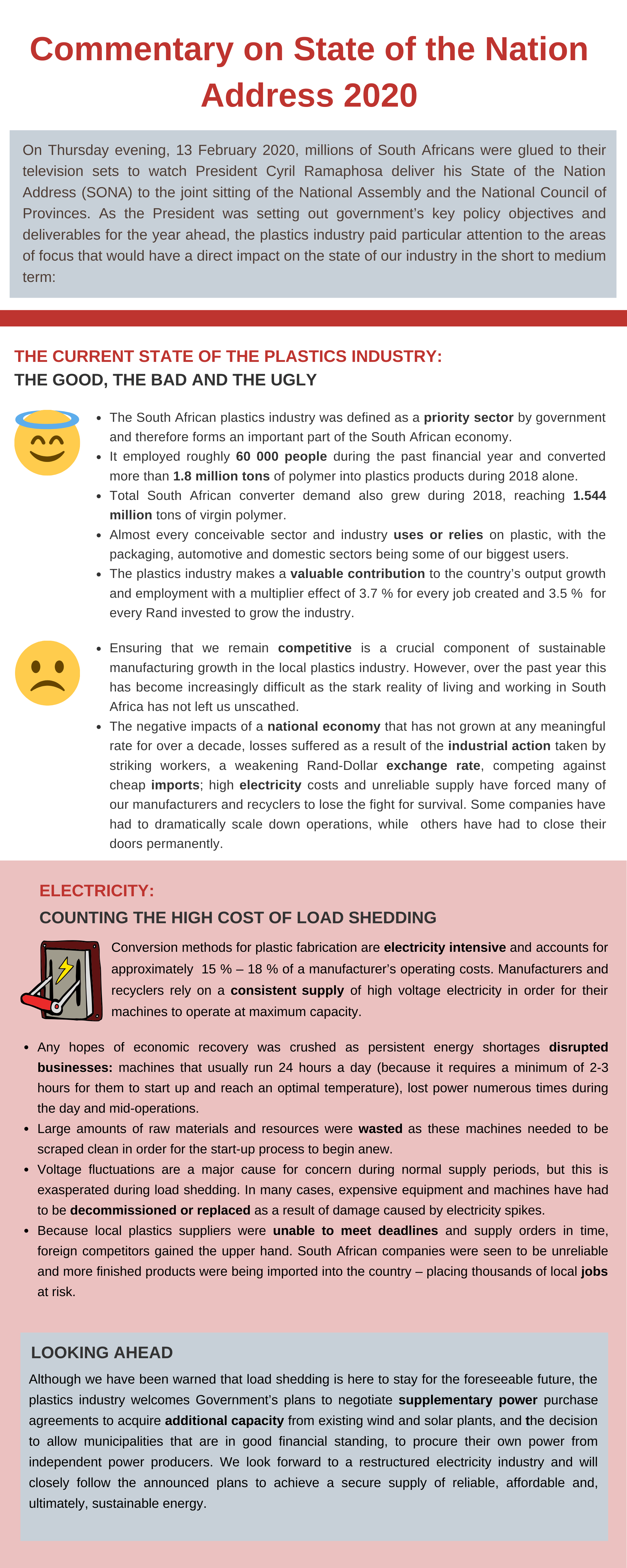
SONA 2020 – How does this impact the Plastics Industry?

On Thursday evening, 13 February 2020, millions of South Africans were glued to their television sets to watch President Cyril Ramaphosa deliver his State of the Nation Address…

Have your say – Draft Position Paper on biodegradable and compostable packaging

The South African Initiative to End Plastic Waste has initiated a process of developing a position paper on biodegradable and compostable packaging in South Africa.

The objectives of this paper are two-fold:
● To provide a balanced perspective and consolidated position for South Africa with regard to biodegradable and compostable packaging, based on sound research and stakeholder inputs.
● To be used to inform players across the value chain, as well as other interested stakeholders around the responsible manufacture, use, management and disposal of biodegradable and compostable packaging.

The paper focuses specifically on the country’s current capacity to responsibly integrate these materials into the existing packaging economy and looks to provide direction on what is required going forward. A supplementary document, “Material types and applications”, highlights the raw material sources, manufacturing process, properties of the polymers, range of applications and end of life fate.

The draft paper is based on a review of academic literature, relevant international standards and engagement with academics and a number of key stakeholders across the value chain, including manufacturers, importers and distributors of the materials, retailers and brand owners, recyclers and commercial composters. In addition, inputs from the Biodegradables discussion group at the recent Plastics Colloquium have been considered.

The draft paper has been approved by the members of the SA Initiative Working Group and is now open for comment from all other interested parties. The paper is available for download:

Draft Position Paper for comment

Material Types and Applications Draft for comment

Please could you forward any comments or suggestions to the Working Group at feedback@mossgroup.co.za as soon as possible.

Polystyrene successes in South Africa

Polystyrene (PS) is the sixth most widely recycled polymer in South Africa. This plastic is lightweight and durable.  It is most commonly used in the food and restaurant industry. In fact, just over 5500 tonnes of PS was recycled in South Africa last year. Polystyrene is one of the most widely-used polymers for food storage and takeaway containers, making it a valuable polymer for the economy.


South Africa has some of the highest recycling rates in the world – last year we recycled 15% more plastic than Europe. Of this volume, PS packaging was the sixth highest polymer in terms of volume processed. Most of the PS plastic waste are fruit and vegetable punnets, meat punnets, takeaway cups and plastic cutlery. These materials are recycled into seedling trays, toys, hair combs and lightweight cement blocks for the building industry.


PS recycling is a successful industry

PS waste is a fairly common material processed at South African recyclers because it is readily available due to its popularity in various industries. PS is popular in retail applications, such as clear food containers, as well as in the food and drinks sector. It also has many uses in the construction industry as expanded polystyrene is a perfect insulator and lightweight building material.


The end-markets for clear containers and expanded packaging polymers, such as PS, are growing steadily year-on-year. The biggest end-market for recycled PS is plastic furniture, followed by domestic houseware. A small portion of recycled PS is sold to the construction sector, although this is a rapidly-growing end-market for this type of recyclate.


PS has a number of beneficial properties

PS is a unique combination of durability, economic viability and environmental performance. It has a low carbon footprint and uses very little energy to manufacture and recycle. One of the main advantages of expanded polystyrene is its resistance to heat, making it ideal for use as coffee cups, food containers and cutlery. PS is non-toxic and non-reactive, which makes it perfect for food contact applications and to prolong the shelf life of edible products.


High-impact PS is transparent and durable, which is why it is commonly used for fruit punnets and CD cases. It shows off the product contained within, while also protecting it during transport and sale. This type of PS is also used to make retail coat hangers, laboratory ware, printers and keyboards, as well as computer and television housings.

___

Plastics SA represents all sectors of the South African plastics industry. ​Together with our associations, we play an active role in the growth and development of the industry and strive to address plastics related issues, influence role-players and make plastics the material of choice.


​Plastics SA has been mandated to ensure a vibrant and sustainable plastics industry in South Africa. The plastics sector is uniquely placed to meet the needs of a sustainable society and to deliver solutions to many challenges such as recycling, climate change, water scarcity, resource usage and energy recovery.


For more news, updates and information on the South African plastics industry, follow us on Facebook, Twitter, Instagram, YouTube, LinkedIn and Pinterest.

Plastic packaging type 5 – PP

Modern life as we know it would not be possible without plastics and plastic packaging. They keep our goods protected, our food fresh and are vital for the functioning of daily life, whether we are aware of it or not. Plastics has many advantages, including cost-effective production and being easy to recycle and reuse. Plastics need to be recycled properly in order to maximise their economic value and to minimise their environmental impact.


To understand more about plastics, we will shed some light on the different types of polymer, their benefits and their recyclability properties, including what products can be made from recycled plastic. We will go according to the material identification codes found on plastics. These are numerical symbols from one to seven that are used to identify the type of plastic.


This coding system is used around the globe by recyclers, waste management companies and plastics manufacturers. It enables them to separate and sort plastics so that they can be processed according to the main polymer present. All plastic packaging should display these material identification codes. The fifth polymer used for plastic packaging is polypropylene (PP).


What is PP?


PP is a hardy, flexible and versatile polymer that is used to manufacture a variety of moulded products, such as dairy tubs for butter and ice cream, plastic furniture, buckets, car bumpers, fibres and woven cloth. PP is the fourth-most commonly recycled polymer in South Africa due to its various applications in daily life. Just under 62 000 tonnes of PP were recycled in South African facilities during the 2018 financial year.


Polypropylene is a member of a group of plastics known as polyolefins. Structurally, it is similar to polyethylene, the difference being that every other carbon in the backbone chain has a methyl group attached to it. Its durability and flexibility make it the perfect polymer for packaging and woven products. Recycling figures for PP over the past five years have shown steady growth, year-on-year. This can be attributed to the fact that more applications are being developed for PP and that a well-established collection network exists.


Benefits of PP packaging


PP has numerous unique characteristics that make it a valuable packaging material. It is one of the most widely-used plastics in everyday life. PP holds colour well, doesn’t absorb water and is ideal for such robust applications as moulded luggage and storage boxes, woven bags and carpet backings, houseware and tools. Its flexibility also allows plastics manufacturers to make hinged products from PP, such as clip-on lids for plastic containers.


PP is a non-toxic and non-reactive plastic, so it can be used in the food and beverage industry to store goods for consumption. The hollow nature of the fibre gives it excellent water (and sweat) absorption properties in clothing and other woven fabrics. These characteristics and benefits make PP a highly valuable plastic packaging material and one of the most recycled polymers in South Africa.

___


Plastics SA represents all sectors of the South African plastics industry. ​Together with our associations, we play an active role in the growth and development of the industry and strive to address plastics related issues, influence role-players and make plastics the material of choice.


​Plastics SA has been mandated to ensure a vibrant and sustainable plastics industry in South Africa. The plastics sector is uniquely placed to meet the needs of a sustainable society and to deliver solutions to many challenges such as recycling, climate change, water scarcity, resource usage and energy recovery.


For more news, updates and information on the South African plastics industry, follow us on Facebook, Twitter, Instagram, YouTube, LinkedIn and Pinterest.

How PE-LD plastic is recycled in South Africa

Low-density polyethylene (PE-LD) is the most widely-recycled packaging polymer in South Africa. It is used to manufacture grocery packets, plastic films, plastic sheets, flexible hoses and cable insulation. PE-LD is fairly easy to recycle and has many beneficial uses – making it the most popular packaging material in the country.


Most of the plastics used for packaging applications are mechanically recycled in South Africa. These materials are often picked, sorted and washed by hand before being processed. PE-LD follows a similar process when it is sent to a recycling facility to be turned into recyclate. Interestingly, there is a 100% conversion rate for PE-LD, meaning that none of the recyclate is wasted or left behind.


How PE-LD is recycled


Firstly, discarded PE-LD packaging is collected by waste management companies and informal waste pickers working at landfills. They source and collect the plastic before bailing them into bundles for transport. These compacted bundles of PE-LD waste are then taken to recycling facilities where the process begins.


The PE-LD bundles are undone and the plastic is separated by grade. Due to the many applications and products made using PE-LD, the materials will have various qualities. The plastic waste is cleaned thoroughly to remove any dirt, debris and contaminants. This makes sure that the PE-LD recyclate batch is pure. Any contaminants or dirt could spoil the entire batch and ruin the quality of the end product.


The PE-LD waste is then fed into a large shredder that turns the plastic into thin strips. These shreds of plastic sheet are then fed into a second washer and float tank, where grains of sand and dirt sink to the bottom of the water tank. The plastic floats on the surface of the water and is skimmed at the end of the tank.


The plastic shreds are then dried and fed into a large oven which melts the plastic into a new sheet which is cooled and dried. This sheet of PE-LD polymer is bailed and sold back to plastics manufacturers and packaging producers. Recycled PE-LD is used to manufacture numerous flexible products, such as bin liners, flexible buckets, irrigation hoses and construction sheeting.


PE-LD can be reused in the home


This polymer is highly durable and can withstand a lot of wear and tear for its weight. Consumers should always aim to reuse their PE-LD packets and plastic sheets before discarding them. Sandwich bags can be washed and reused, as can Zip Lock bags. Grocery bags made from PE-LD can be used again and again when visiting the supermarkets.


Contractors and painters can reuse their black plastic sheeting multiple times before throwing it away. The flexibility, lightweight and durability of this polymer lends itself to multiple reuse, making PE-LD a valuable plastic. By reusing these products, consumers can save a lot of money. If discarding PE-LD is necessary, at least it can be recycled, which benefits the local economy and the environment.

___


Plastics SA represents all sectors of the South African plastics industry. ​Together with our associations, we play an active role in the growth and development of the industry and strive to address plastics related issues, influence role-players and make plastics the material of choice.


​Plastics SA has been mandated to ensure a vibrant and sustainable plastics industry in South Africa. The plastics sector is uniquely placed to meet the needs of a sustainable society and to deliver solutions to many challenges such as recycling, climate change, water scarcity, resource usage and energy recovery.


For more news, updates and information on the South African plastics industry, follow us on Facebook, Twitter, Instagram, YouTube, LinkedIn and Pinterest.

Bioplastics are not the same as biodegradable plastics

When it comes to plastic alternatives, there are two materials that consumers are likely to encounter; bioplastics and biodegradable plastics. These are separate products that are often confused. People think that bioplastics and biodegradable plastics are one and the same, but in reality, they are not.


Both of these materials are fairly new developments that are growing in popularity around the world, as well as in South Africa. They are both marketed as alternatives to traditional plastics and are used in similar applications. However, that is where the similarities end. The differences between bioplastics and biodegradable plastics are outlined below.


What are these materials made from?


Bioplastics are not just one single material but comprise of a whole family of materials with different properties and applications. “Bioplastics” refers to plastics made from plant or other

biological materials – it does not speak to the biodegradability or compostability of the

Product. Bioplastics are made from corn, sugar cane or starch. They have the same characteristics as oil-based plastics but are made from renewable sources.


Biodegradable plastics, on the other hand, are made from fossil fuels such as oil. In theory, they can be degraded by biological processes. However, many so-called biodegradable plastics do not decompose as intended in the natural environment. Biodegradable plastics are not always bio-based (made from plants) and bioplastics are not always biodegradable.


Why use bioplastics?


The main benefit of bioplastics is that they are made from naturally-occuring and renewable materials. They reduce our reliance on fossil fuels and oils which also helps to lower carbon emissions. Bioplastics can be made from genetically modified plants or from natural feedstock – neither of which are food sources for humans. These resources can be regrown every year, unlike oil and fossil fuels.


Another advantage of bioplastics over biodegradable plastics is that they can be recycled with conventional packaging waste. Bioplastics can be processed at a recycling facility in the same way as regular plastic, whereas biodegradable plastic must be separated from the waste stream and processed separately.


Bioplastics are perfectly suited to mechanical recycling. On the other hand, biodegradable plastics must be sent to an industrial composting facility where they can take up to three months to decompose. Manufacturing bioplastics is a fairly complicated process and quite an energy-intensive operation, but as the technology develops and further tests are completed, we could soon see plastic products being made from green resources.

Winner of Caroline Reid Award 2019 announced

Alison Bryant of the Keep Plett Campaign is the winner of the Caroline Reid Award for the Cleanup Champion of 2019 – a  new, annual award established by Plastics|SA to recognise and reward excellence in South Africa by an individual in the field of marine and coastal clean-ups.

Making the announcement during a gala dinner to celebrate the 20th Anniversary of the Marine & Coastal Educators Network (MCEN) held at the Zeekoevlei Yacht Club in Cape Town last week, Douw Steyn and John Kieser of Plastics SA awarded Alison with a R10 000 cash prize and a  floating trophy.

Read more.